
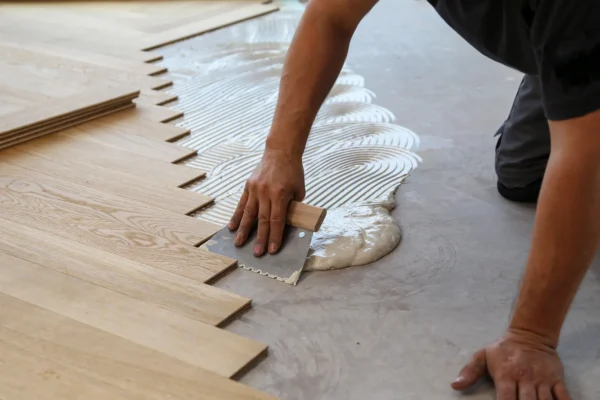
A person smoothly installing laminate flooring planks with a curved edge.

Everything You’ll Need

ToolLuxury Vinyl Plank (LVP)Luxury Vinyl Tile (LVT)Sheet Vinyl
Utility Knife
Tape Measure
Straight Edge
Pry Bar
Spacers
Tapping Block
Non-Marring Hammer
Squeegee
Grout Float
Notched Trowel
Floor Roller
Heat Gun
Seam Roller

Step 1: Prepare the Space

Take Off Baseboards and Old Floors

Start by taking off any baseboards and old floors in the room. This will make the floor ready for new vinyl planks.

Use a pry bar to gently remove the baseboards without harming the walls.

If lifting carpet, cut it into small pieces with a utility knife and pull it up. For other floors, remove them using the right method.

Clean the Subfloor and Fix Cracks or Uneven Areas

Sweep and vacuum the subfloor well to clear out all dirt and debris. Check for any cracks or uneven spots.

Use a leveling compound to fill gaps or low areas, and sand any high spots to make it smooth.

Add Underlayment for Extra Cushion and Quietness

Adding underlayment can make the floor softer and quieter, though it’s not required.

If you use underlayment, roll it over the subfloor and stick it down with tape, making sure there are no gaps or overlaps.

Step 2: Pick a Pattern or Design

Vinyl flooring can be installed in many ways, giving your space a fresh look.

These patterns suit various styles, from old-fashioned to modern, letting you create beautiful floors that match your home.

Check out some popular vinyl flooring patterns to inspire your home improvement.

Straight Lay Pattern

Straight Lay Pattern

In the straight lay pattern, vinyl planks are placed in a straight line, following the walls. This simple style looks neat and works in any room.

Diagonal Pattern

Diagonal Pattern

The diagonal pattern places planks at a 45-degree angle. This creates a lively look and can make rooms feel bigger.

Herringbone Pattern

Herringbone Pattern

The herringbone pattern uses a zigzag layout, creating a V shape. This adds elegance and texture, making it a favorite for entryways and dining rooms.

Chevron Pattern

Chevron Pattern

In the chevron pattern, planks form a continuous zigzag. This pattern adds a modern feel, perfect for trendy spaces.

Parquet Pattern

Parquet Pattern

Parquet patterns use shapes like squares or diamonds. These designs can be simple or complex, adding a touch of sophistication.

Mixed Patterns

Mixed pattern

Combining patterns in one space creates a unique look. For example, you might mix a straight lay with a herringbone border or make a checkerboard using different colors.

Step 3: Choose an Installation Method

There are different ways to install vinyl plank flooring. Each way has its own pros and cons, depending on the vinyl type and your installation needs.

GripStrip Method

GripStrip Method

GripStrip, or peel-and-stick, is easy and good for DIY projects.

Each plank has a sticky back. You peel the film and stick it to the floor.

This works best with Luxury Vinyl Plank (LVP), which is thicker and can handle the sticky backing.

It might not work well with thinner vinyl types like Luxury Vinyl Tile (LVT) or Sheet Vinyl.

Click-Lock Method

Click-Lock Method

Click-Lock, or interlocking, uses planks with edges that snap together tightly.

No glue is needed, and the floor can “float” over the base, adjusting to temperature and humidity changes.

This method is good for LVP, LVT, and some Sheet Vinyl.

Take Note:

  • Follow the manufacturer’s instructions for correct plank alignment and locking to avoid gaps or uneven seams.
  • Use spacers by the walls to keep the expansion gap, letting the floor move without issues.

Glue-Down Method

Glue-Down Method

Glue-down involves applying glue to the subfloor and pressing planks onto it.

This method is strong and ideal for busy areas or commercial spaces needing durability.

It provides a stable installation that handles heavy use and moisture.

Take Note:

  • Use a high-quality adhesive recommended for vinyl flooring.
  • Work in small sections so the glue stays sticky during installation.
  • Use a rolling pin or heavy roller to press planks into the glue for a firm bond.
  • Let the glue cure before walking on the floor or placing heavy items.
Step 4: Lay the First Row

Cut the Short Tongue Edge of the First Plank

To begin the first row, cut off the short tongue edge of the first plank. This helps it fit snugly against the wall. Use a utility knife to carefully cut along the tongue edge.

Place the First Plank 1⁄4 Inch from the Wall

Put the first plank about 1⁄4 inch from the wall. This space lets the floor expand with changes in temperature and humidity. Use spacers along the wall to keep this gap.

Put Spacers Along the Walls for Expansion

Put spacers between the planks and the walls to keep the 1/4-inch gap for expansion. These spacers will ensure your flooring can adjust properly.

Step 5: Cutting Planks to Fit

Use a Utility Knife to Cut and Snap Planks

To cut planks to fit corners and edges, use a utility knife to mark the plank along the cut line. After marking, just snap the plank along the line for a clean break.

For Curved Cuts

A jigsaw or oscillating tool is better for curved cuts, like around door frames or pipes. These tools make precise cuts and can handle tricky shapes. Learn how to use a jigsaw here.

Cutting Planks Around Pipes

Measure the pipe’s width and add an inch. Drill a hole in the plank matching the pipe’s width plus the extra inch. Then, cut the plank to fit around the pipe, leaving a half-inch gap for expansion. Lastly, put the plank in place and seal the cut piece with silicone caulk.

For Tight Spots Like Under Door Jambs

Use a jamb saw to cut planks for tight spots, like under door jambs. A jamb saw makes precise cuts close to the floor, helping the planks fit snugly.

Step 6: Laying Subsequent Rows

Fit the Tongue of the Plank into the Groove of the Row Before

When adding more rows, fit each plank’s tongue into the groove of the row before. This locks the planks together for a strong connection.

Use a Tapping Block and Soft Hammer

For a snug fit, gently tap the planks into place using a tapping block and soft hammer. Don’t use a regular hammer directly on the planks to avoid damage.

Step 7: Finishing the Installation

Install Transition Strips

After laying all the planks, put transition strips at doorways and between rooms. This makes the floor edges smooth and safe. Follow the maker’s guide for putting in transition strips.

Transitioning to Other Flooring

To move to a different flooring type, use a T-molding or reducer strip. Attach the strip to the subfloor for a strong and neat finish.

Leave a 1/4-inch gap between the vinyl planks and the strip. This gap helps with movement and stops buckling.

Reinstall Baseboards

Put back the baseboards, making sure they are fixed to the wall, not the floor. This allows the floor to move without problems.

Allow the Floor to Acclimate for 48 Hours Before Use

Let the new floor sit for 48 hours before using it or putting furniture on it. This time helps the floor get used to the room’s temperature and humidity.

Common Things to Avoid When Installing Vinyl Floors

Areas with Too Much Moisture

Vinyl plank flooring is not good for places with too much moisture, like bathrooms. Water can get into the seams and make the planks warp or peel.

Using a Rubber Mallet or Hammer on Planks

Hitting the planks with a rubber mallet or hammer can damage them. Always use a tapping block to keep the planks safe during installation.

Don’t Overlap Plank End Joints in Rows

Do not overlap the end joints of planks in rows next to each other. Overlapping can make the floor weak and uneven.

Walking on Floor During Acclimation Time

Stay off the floor for 48 hours during the acclimation time. This period is important for setting the floor right to last long.

Tips for a Successful Vinyl Flooring Installation

  • First, measure the room carefully to know how much flooring you need. Add 10% extra for any mistakes or cuts.
  • Check each plank before you start. Throw away any damaged ones for a perfect look.
  • Wear a knee pad for comfort while working. It will protect your knees and make it easier.
  • Go slowly and be careful to avoid errors. Taking your time helps you get a professional finish.

Installation Costs for Vinyl Plank Flooring

Vinyl plank flooring installation has different costs based on the method:

  • Peel-and-stick: Usually costs $1.50 to $8 per square foot.
  • Glue-down: Prices range from $2.50 to $12.50 per square foot.
  • Floating/Interlocking: Costs between $3 and $13 per square foot.

Labor costs are $1 to $3 per square foot depending on how complex the installation is.

You might also need underlayment, costing $0.50 to $1.00 per square foot, and transition strips and trim, which range from $1 to $5 per linear foot for a neat finish.

Do You Need Professional Help With Your Vinyl Flooring Installation Project?

Now that you know how to install vinyl plank flooring, you’re ready to have a strong, nice-looking floor. If you want experts to do it, we can help.

Our flooring installation team does it all — from getting the subfloor ready to placing each plank perfectly — so you can sit back and enjoy great results. We’ll also help you pick the best vinyl flooring for your room, whether it’s luxury vinyl plank, sheet vinyl, or tile.

Contact us today to book your free home consultation and check if we serve your area.